Stitched Atlas Folk met at Herefordshire Archive and Records Centre (HARC) on Monday 11th March to set up our halfway exhibition of our work in progress and demonstrate our processes towards creating The Stitched Atlas. The day was exactly the halfway point since the introductory session last 11th September. Six months have flown by and I feel very lucky with the group who are all volunteering their time and creative ideas in this project. The group are so very generous with sharing and helping each other and stimulating new ideas and directions in each other’s work.


Setting up the exhibition was a joy, everyone working together to build the displays, some staying way into the afternoon and others returning over the next two days to complete the displays. We had an evening opening event on the Thursday 14th and sang Maggie’s new folk song.
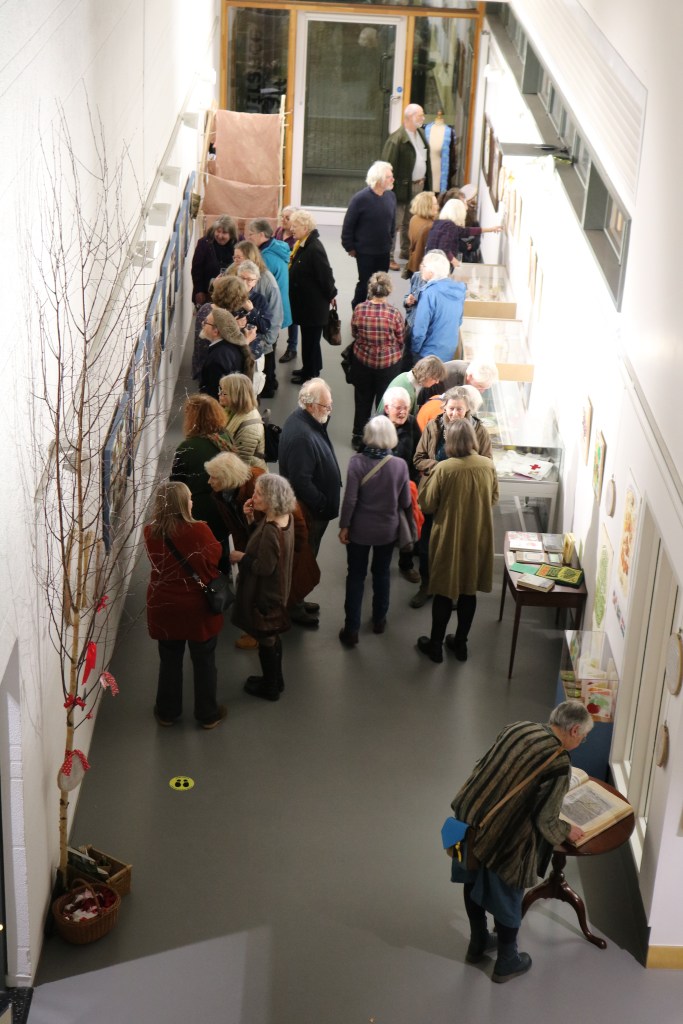
A big thank you to HARC for hosting us and Senior Archivist Rhys Griffiths for his wonderful introduction at the opening. We have included interactive elements in the exhibition, in the hope that children may also be brought along and be inspired by the folklore and folksongs of Ella Mary Leather and the ways in which Stitched Atlas Folk are responding to these in the places they are investigating. We hope you can pop along to see the exhibition. It is on until 20th June 2024.
Below is the information sheet I have written to go with the exhibition.
BETWIXT

An exhibition by Stitched Atlas Folk at Herefordshire Archive and Records Centre
March 12th - June 20th 2024

About the exhibition
This exhibition is at the halfway point of a community participatory textile project exploring rural places in Herefordshire through the stories, songs, tunes and dances collected by folklorist Ella Mary Leather (1874 - 1928) at the beginning of the 20th Century. It is one of two case studies contributing to my arts practice PhD research which is investigating rural place. For this case study, I invited participants to meet weekly for a year to each explore a personally chosen place from the substantial material that Leather collected. My primary sources are her published book The Folk-lore of Herefordshire (1912) and her notebook of songs and tunes held in Vaughan Williams Memorial Library (VWML), Cecil Sharp House, London.

Creating a Stitched Atlas together
Sixteen women volunteered for the project and together we are creating a Stitched Atlas of the places we investigate. The group decided to make the finished Atlas the same dimensions as Leather’s notebook and this will be completed in September this year.  We are using embodied methods of ‘walking as stitching’ (imagining our body as a needle as we walk on the land) and ‘stitching as mark making’ (requiring no prior knowledge of needlework) to re-experience this folklore material in the places it is associated with. I have tasked participants with visiting their chosen place a minimum of once each season.

The folklore and folksong material were originally collected from ordinary ‘uncelebrated’ rural people of that time, and it feels appropriate that ordinary folks from today’s community are revisiting and responding to this heritage. However, working with the material from the former group and the wonderful generosity and sharing I’ve found in the creative process with the latter group, I will say that I consider both groups of people extra-ordinary!

The 150th anniversary of Ella Mary Leather’s birth
The 26th of March this year is the 150th anniversary of Ella Mary Leather’s birth. She was born on a farm in Bidney near Dilwyn, and then lived in Weobley after her marriage at age 19 years. The latest edition of her book by Logaston Press (2018) has an excellent biography written by John Simons. There is also a great film by Mad Pie Productions  on YouTube ‘She who saved the stories – The Life of Ella Mary Leather’(2023). Leather was also the Commandant for the Red Cross Voluntary Aid Detachment at Sarnesfield Court during the First World War, and the exhibition shows copies of some pages from its book of patients, held here at HARC.  I have replicated her uniform apron and medals as seen in a portrait of her. I have also found a list of names of other staff she worked with at Sarnesfield Court, at least one already familiar from the folksong archive.

Inspiration and development of my research project ‘Stitching Folklore in Place’
In 2012 when walking in Hough Woods I first heard of the legend of The Dragon of Mordiford and then The Mermaid of Marden and was astonished when I came across the Marden bell in Herefordshire Museum and these led me to Ella Mary Leather.  In 2018 I conceived my PhD arts research idea to revisit these places of legend and was accepted for part time study at Manchester Metropolitan University in October 2019 supervised by Professor Fiona Hackney, Dr Elizabeth Kealy-Morris and Dr Lynn Setterington.

In February 2022 I spent three fabulous days with Leather’s notebook and was hugely inspired by the snippets and scraps of paper within it, so suggestive of the community of people who helped her collect the folksongs and tunes for fear of them being lost. One was a folded note and I imagined it being passed hand to hand, pocket to pocket.  There was a sense of paper not being wasted, with one note written on the back of a programme for an entertainment that Mrs Leather organised.

In 2022 I ‘took’ Ella Mary Leather to Reykjavik for RE:22 Nordic Ethnology and Folklore Conference and gave a presentation about her life and work as well as the findings from my pilot project ‘The Lugg Embroideries’. The latter was directly inspired by my seeking out the Gospel trees, which Leather records as a last remaining trace of the custom of ‘Beating the Bounds’.  Whilst searching for The Gospel Oak at Mortimer’s Cross, I found the River Lugg, or perhaps it found me?  It is a river under threat from pollution.

Research progress
Since 2022 I have been planning this halfway exhibition as a creative outcome to showcase our work in progress as The Stitched Atlas develops. It is great to have this coinciding with Leather’s anniversary to redress the balance of her relative obscurity compared to the more famous men associated with the First Folklore Revival. Certainly, just one of the themes emerging from this research is of women hidden or misrepresented in history in Herefordshire. There is a resonance with Leather’s own life that this contemporary group of women have stepped forward to restitch some female stories in place.

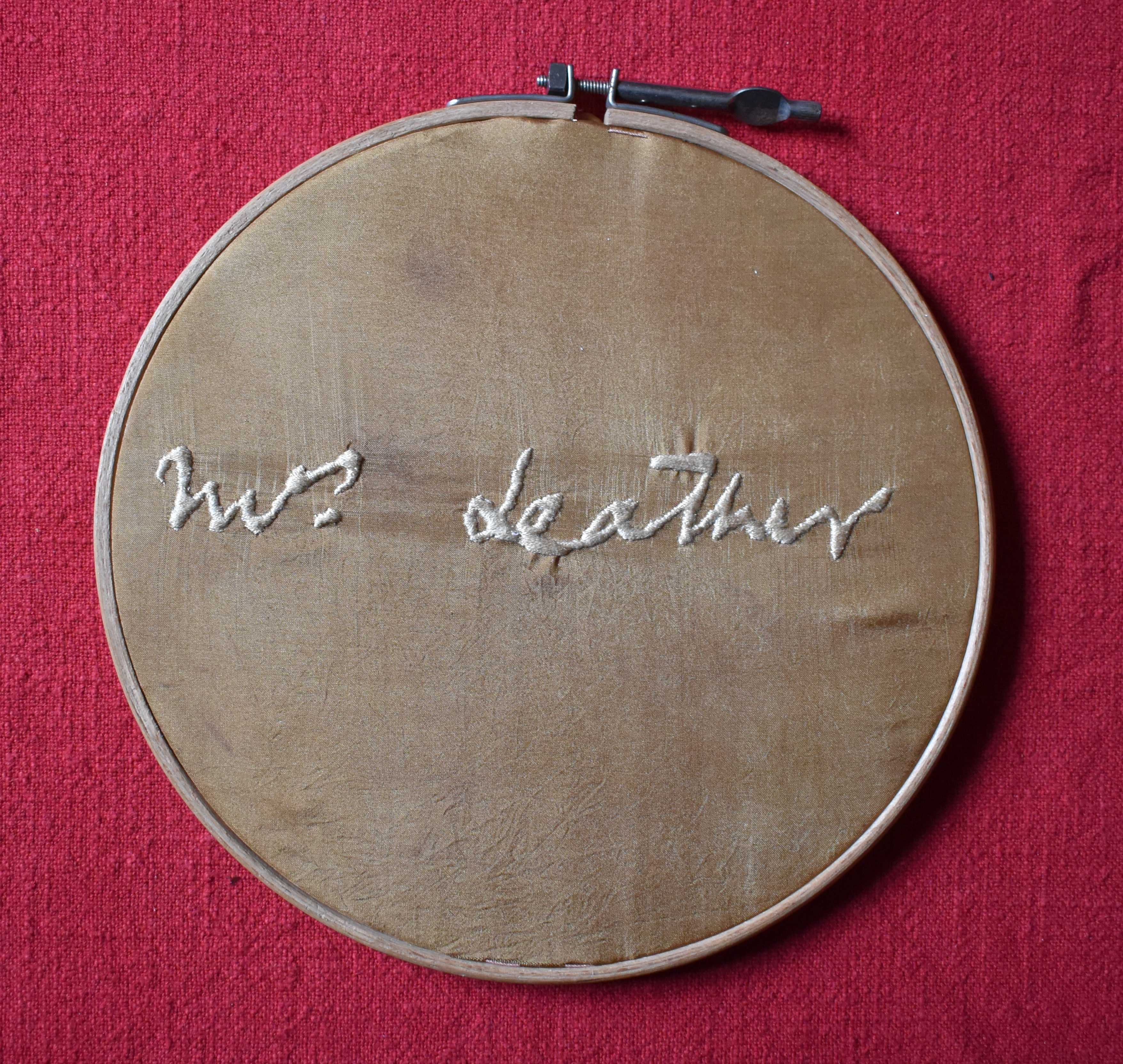
In July 2023 I asked Leominster Priory Choir if they might be able to perform some of the ‘Twelve Traditional Carols from Herefordshire’ that Leather and Ralph Vaughan Wiliams (RVW) published in 1920 to launch Leather’s anniversary year and was delighted when they agreed and incorporated three into Leominster Priory Christmas Service. My huge thanks to Hilary Norris and her choir for all their work. It was amazing to hear the songs, which sounded quite tricky to perform. The choir also ‘donated’ their handwriting to rewrite some of the names of the past collectors/transcribers/performers that worked with Leather. You can see these stitched onto the lining of the dress in this exhibition.

To re-experience a folksong in its place, I have organised a performance of a song by Gypsy tenor Alfred Price Jones that Leather collected in a Monkland hopyard in September 1912, alongside RVW. This is on her actual birth date and the event has expanded into a community celebration in the style of one of the entertainment’s that Leather used to organise.

Recreation of the dress Ella Mary Leather is wearing in a posthumous portrait
Part of my research methods are to create a key piece for each of my case studies. The dress exhibited is a re-creation of Leather’s dress which she is pictured wearing in her posthumous portrait by F. M. Bennett. The portrait was commissioned by her husband after her unexpected death at age 54 years in 1928. She is pictured in her study at Castle House, Weobley. I sought advice from many people about the materials and the style of the dress. My thanks especially to Gerry Connolly at Worthing Theatres & Museum who advised that it is in the style of the Dress Reform Movement of the late 19th and early 20th century where design was more fluid and less structured. He also commented that the background of the portrait has a feel of the Arts and Craft Movement and wondered if Leather was influenced by this, as it would fit with her subject of folklore. The Royal Horticultural Society also advised me that they believe the red Nasturtium flowers in the portrait to be ‘Empress of India’ which were an 1885 introduction to Britain often seen in late Victorian paintings to symbolise ‘victory in struggle’.

The dress is made from scratch, with the velvet material hand dyed, and the blue lining reused from a 1930s cloth which already had some hand embroidery on it.  The Celtic knot embroidery pattern on the lapels is taken from Leather’s gravestone in Weobley Churchyard. Please do look at the lining to see all seventy-six names of people who helped Leather collect folksong/tunes or performed for her. These are patched onto the lining of her dress, referencing her notebook of snippets of tunes / songs. The colours of the silks and some threads are hand dyed with plant materials. Some of the dyes were made in a workshop in October 2020 led by the remarkable textile artist, the late Linda Row. The stitched names of the people from the past are written in handwriting ‘donated’ by contemporary people in Herefordshire.

Stitched Atlas Folk
This exhibition has been put together by Stitched Atlas Folk with the purpose of showing how our ideas are developing as we move through the intersection of folklore and place.  The boards show data gathered from participants’ fieldwork of their chosen place. The cabinets have individual embroideries completed which will contribute to Atlas pages about apotropaic marks, autumn and winter seasons, music, and dance. Some completed pages are framed. Apples and pigs and associated folklore have also been emerging themes.  We are embroidering pages with the bell rhymes to add another rhythm through the Atlas, and photographs of these are in the book on the chair. Another theme has been the handing down of tradition be it a skill or a story and a few items in the exhibition were our grandparents or great grandparents.

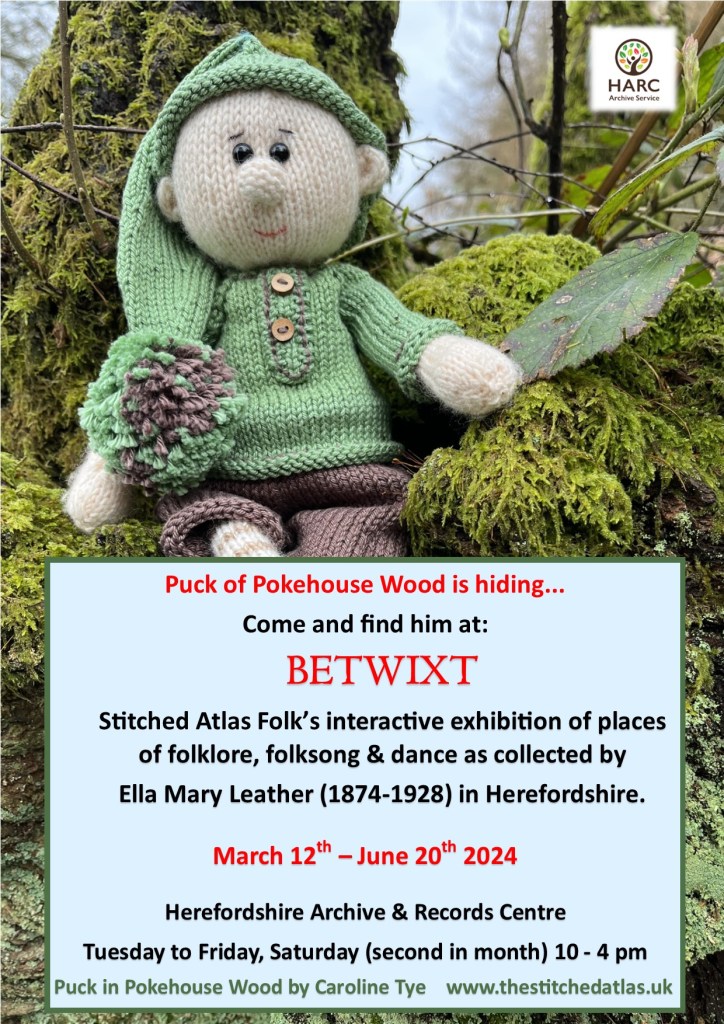
Additionally, we have added activities for primary school age children to engage with both the map, folklore, customs and traditions, as well as the creative process. This idea came from the arrival of a knitted Puck from one of the stories of place!

The Stitched Atlas Folk & their personal places under investigation

Maggie Crompton: 	Leominster (& all poems)
Francesca Davies: 	Mordiford & Dorstone
Caroline Gerstad: 	River Wye in Hereford & Hay
Chris Hemming: 		Bodenham
Annie Henderson: 	Much Cowarne
Jackie Morris: 		Monkland
Liz Morison: 		Brinsop & Burghill
Maggie Percy: 		Dilwyn
Ali Price: 		Eaton Bishop
Karen Ramsay: 		Kings Pyon
Julia Reynolds: 	Places of Apples
Helen Richards: 	Upper Hill
Mary Roberts: 		Hereford
Caroline Tye: 		Aymestrey
Helen Watkins: 		The Bacho, Madley
Meg Williams: 		Withington
Annie Wood: 		Leominster

Acknowledgements: Our grateful thanks to all the team at HARC and the friendly team at Leominster Information Centre where Stitched Atlas Folk meet in the Council Chamber.

Notes on The Stitched Atlas project by artist: researcher: facilitator Jackie H Morris
jacqueline.morris@stu.mmu.ac.uk
Project blog: www.thestitchedatlas.uk
 The Stitched Atlas