Film: Caroline G recommended this film ‘The Nettle Dress’ which is touring the country. I saw it last week, regular walking in a wood and a creative response is a main feature of it. Main themes are loss and memory. Its use of the drop spindle promteda request from the group to be taught spinning, by weaver Maggie P, which she kindly did in our last meeting before Christmas. Thank you Maggie . https://www.nettledress.org/
Radio: Anne shared this series BBC Sounds-Witch. The witch has held a place firmly in our imagination for centuries – from whispered warnings in folklore to pop-culture driven heights. But what does it mean to be a witch now? Presenter India Rakusen, creator of the podcast 28ish Days Later, is on a journey to find out. Available at https://www.bbc.co.uk/programmes/m001mc4p
Book: A related book is Caliban and the Witch by Silvia Federici , as highighted by Caroline and Ann https://www.londonreviewbookshop.co.uk/stock/caliban-and-the-witch-women-the-body-and-primitive-accumulation-federici-silvia
Exhibition and material supplies: Helen shared this exhibition at The Courtyard by Rose Tinted Rags. It has now ended but if you are in need of any threads or fabrics, RTR has a fabulous shop on Hereford Bus station selling pre-loved materials. RTR took part in my pilot research project The Lugg Embroideries which is when I got to know them better, and I am a huge fan of theirs, always amazing cretaivity and fun going on there! https://www.courtyard.org.uk/events/rose-tinted-rags-exhibition-2023/
YouTube: Helen recommended Gathering Moss – ‘What can the planet’s oldest plants teach us about our humanity and our place in the world? For this unmissable event Robin Wall Kimmerer, acclaimed thinker, writer and director of the Center for Native Peoples and the Environment, is in conversation with journalist Lucy Jones, author of the best-selling book Losing Eden. Living at the limits of our ordinary perception, mosses are a common but largely unnoticed element of the natural world. Robin Wall Kimmerer’s book Gathering Moss is a beautifully written mix of science and personal reflection that invites us all to explore and learn from the elegantly simple lives of mosses. How do mosses live? And how are their lives intertwined with the lives of countless other beings? Kimmerer explains the biology of mosses, while at the same time reflecting on what these fascinating organisms have to teach us. Drawing on her experiences as a scientist, a mother, and a Native American, Kimmerer explains the stories of mosses in scientific terms as well as within the framework of indigenous ways of knowing. The natural history and cultural relationships of mosses become a powerful metaphor for ways of living in the world. In conversation with Robin is journalist Lucy Jones- author of Losing Eden, which explores how and why connecting with the living world can so drastically affect our health. Urgent and uplifting, Losing Eden is a rallying cry for a wilder way of life, one which might just help us to save the living planet, as well as ourselves.’ https://www.youtube.com/watch?v=c3FSpMMzUNI
Book: Julia recommended Robin Wall Kimmer’s book ‘Braiding Sweetgrass’
Exhibition: Jackie recommended use of dressmaking pins and laundry pulleys (highlighting women’s work) as used by Helen de Main and Mandy McIntosh in their exhibition ‘Repeat Patterns‘ at Glasgow’s Gallery of Modern Art https://galleryofmodernart.blog/portfolio/helen-de-main-mandy-mcintosh-repeat-patterns/
Storytelling and spinning 13th – 15th February 2024: Helen saw this advertised: Telling Tales & Spinning Yarns Hear about the importance of wool processing & spinning for textile production in Herefordshire through the ages. Watch spinning demonstations & have a go at drop spinning. Listen to stories of Roundheads, Cavaliers & Hereford under Siege during the Civil War, in the company of Royalist Colonel, Sir Barnabus Scudamore. https://www.herefordshire.gov.uk/events/event/1360/telling-tales-spinning-yarns-at-the-black-and-white-house-museum
Textile Museum: Jackie reported an inspiring visit to Trefriw Woollen Mills whilst on a long weekend break to Snowdonia. https://www.t-w-m.co.uk/
Embroidery artist: Karen shared a link to Amanda Cobbett who is a wonderful lichen embroidery artist. A load of lichen had blown down from the trees in Betws-y-Coed so Jackie had gathered a bag load to test in a natural dye bath. Here is her website, she also embroiders fungi https://www.amandacobbett.com/moss-and-lichen
Land artist: Maggie C shared her admiration for the nature based art of Andy Goldsworthy and liked the idea of stitching with natural materials. See https://andygoldsworthystudio.com/
Embroiderer: Francesca shared the Instagram page of the work of Ange at L’Atelier d’Ange see @ecoleange and the helpfulness of her videos on different stitches and techniques
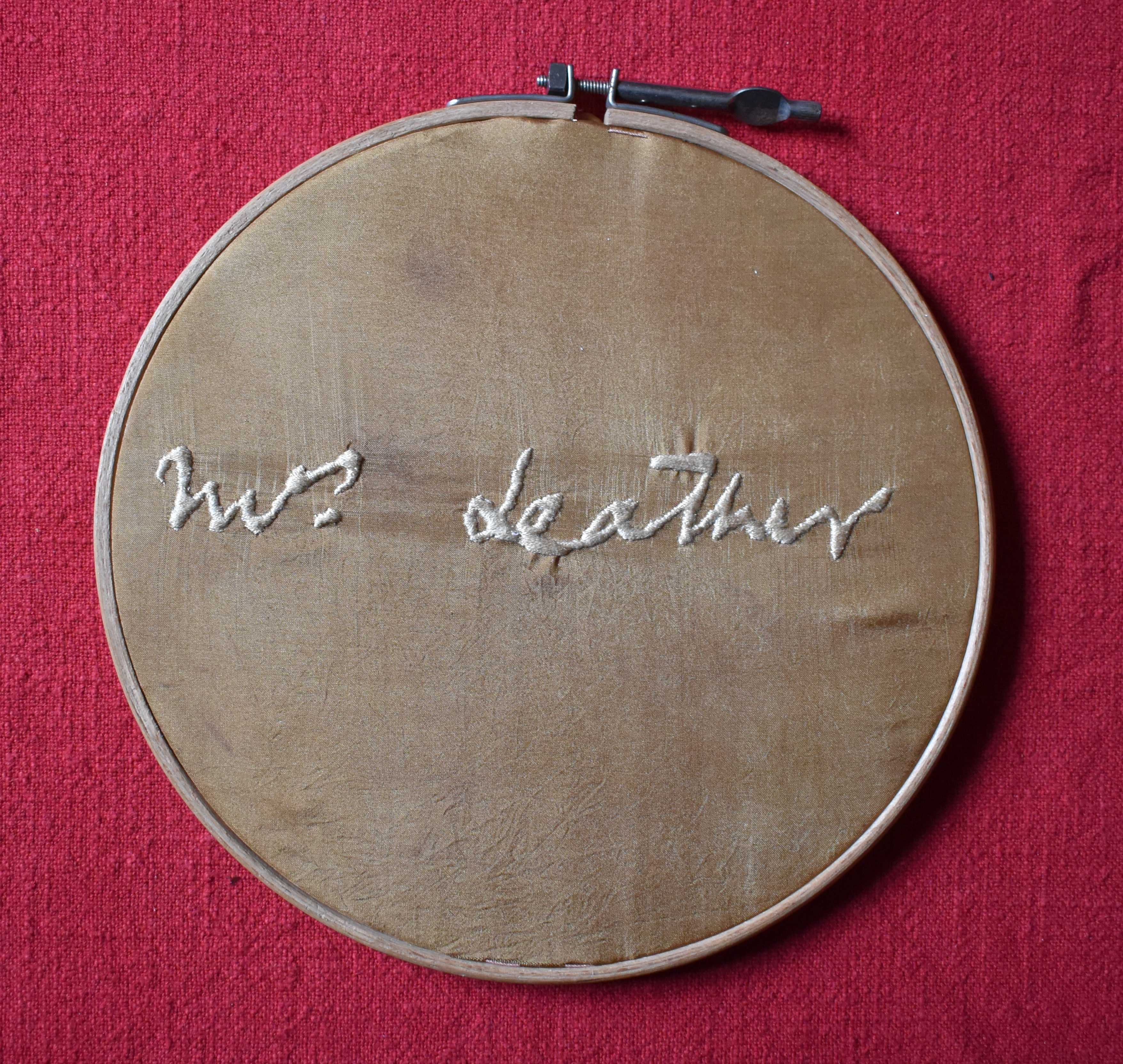
EVENT: The Service of Nine Lessons and Carols: Hilary Norris and her Leominster Priory Choir are performing 3 Herefordshire carols as collected and published by Ella Mary Leather and Ralph Vaughan Williams in this Service on Sunday 17th December at 6 pm. Jackie had asked Hilary in the summer if it might be possible as a launch to the celebrations of the 150th anniversary of Ella Mary Leather’s birth in 2024. Additionally Back In early September, many of the choir had ‘donated’ their handwriting to rewrite the names of folk who either helped Ella Mary Leather to collect local tunes and words or performed for her. These names are now stitched onto silk and are being patched onto the lining of the recreation thta she is wearing in a posthumous portrait. The idea of patching on echoes the scrapbook appearance of collected notes in Mrs Leather’s note book held in the Vaughan Williams Memorial Library Archive in Camden.
Old Christmas carol: Here’s a link to an old carol sung by the wonderful Angeline Morrison that Angeline shared on her Instagram page : Roud 808 : “Christmas is Now Drawing Near at Hand”. She describes it as a “dark, fascinating and rather moralising carol …apparently popular with beggars around the festive season. It was also collected from Traveller people in the West Midlands, by both Sharp & Vaughan Wiliams. A version was printed in Birmingham in 1910. A version was also collected in Camborne, Cornwall in 1913. I first heard this from the glorous singing of Lal Waterson on The Watersons’ 1965 classic, Frost and Fire. Now here’s my lovely new harmonium, Haunted Ernestine, and I making our own way through it ” (AM 15th December 2023) You Tube link https://www.youtube.com/watch?v=SDSOP5kOK04
Learn lesser know carols: Ann shared this link to a group in Bishops Castle for anyone interested in learning lesser known carols: https://castlecarols.com/ and said that in lockdown folks joined from all over the world.
Learn about lichen and bryophytes: Caroline G shared a beginners course to discover lichens and another to discover bryophytes, both taught online. See https://www.field-studies-council.org/courses-and-experiences/static-courses/discovering-lichens-online/ and https://www.field-studies-council.org/courses-and-experiences/static-courses/discovering-bryophytes/
Radio: Karen shared this series BBC- Mythical Creatures : Fantasy writer Rhianna Pratchett takes us across an enchanted British Isles to discover mythical creatures that lurk in all corners of the land. She uncovers what they can tell us about our history, our world and our lives today.https://www.bbc.co.uk/programmes/m001tgpb
Embroidery artist: Helen shared information about an embroiderer of aerial landscapes, she has an instagram account: Victoria Rose Richards. Her website is https://victoriaroserichards.co.uk/
Herefordshire folk song tutorial: Annie shared a tutuorial and recording of the Marden Forfeit Song by our local Fetch Theatre and the Bellringers of Marden as taught by Mary Keith: see https://www.youtube.com/watch?v=6QyZtNoRUwA
Wassailing tradition: Jackie shared artist Lucy Wright’s Instagram post revisiting The Wassail Tradition. See https://www.instagram.com/lucy_j_wright/p/C1EQ2fuI6f1/?hl=en-gb&img_index=1 Her website about all her folk focussed work is https://www.lucywright.art/
Old tale: Jackie posted about the 14th century Christmas / New Year tale Sir Gawain and the Green Knight. There are photos on this wikipedia page of the only surviving manuscript Cotton Nero a.x, whose colours are lovely. It includes lots of poetry and talks of a ‘rhyming bob and wheel’ and Jackie was curious to know what that is, it reminded her of the movements we experienced of the drop spindles and also those used in change ringing of church bells. See https://en.wikipedia.org/wiki/Sir_Gawain_and_the_Green_Knight. Ann recommended Simon Armitage’s translation of the book. Karen posted this information about Bob and Wheel: https://en.wikipedia.org/wiki/Bob_and_wheel It says “Bob and wheel is the term for a pairing of two metrical schemes. The wheel is a type of rhythm used in hymns or narrative songs sung in European churches or gatherings from the 12th to the 16th Centuries. A wheel occurs when at the end of each stanza, the song and the lyric return to some peculiar rhythm. In some instances the wheel is a return to something that resembles no definable poetic rhythm. A bob is a very short line, often two assertive syllables that announces the start of the wheel.”
Carol origins: Caroline G recommended Lucy Worsley’s exploration of our favorite carols ‘Lucy Worsley’s Christmas Carol Odyssey’: https://www.bbc.co.uk/programmes/m000c5y4
Straw plaiting & corn dollies : Veronica main’s instagram shows a piece of mistkletoe plaited from straw https://www.instagram.com/hat.plait/p/C1FLKJmoOmd/?hl=en&img_index=1 Her website is https://www.hatplait.co.uk/ and she has a new book out Straw Plaiting Heritage Techniques for Hats, Trimmings, Bags, and Baskets. On the subject of corn dollies Julia shared that the right corn for making them is Maris Widgeon.
The Herefordshire Hoard: Caroline G shared a link to an event showcasing the Hoard in January. It was discovered in Eye, near Leominster. See https://www.herefordshirehoard.co.uk/
Exhibition: Unravel – The Power and Politics of Textiles in Art at The Barbican 13th Feb- 26 May 2024 https://www.barbican.org.uk/whats-on/2024/event/unravel-the-power-and-politics-of-textiles-in-art
Welsh tradition : Calennig or New Year tradition explained by Rosamund Black of The Museum of Welsh Textiles in Whitton. She tells the wonderful story in instalments on her Instagram and Facebook page. She also has a shop in Presteigne worth popping into for nuggets of textile knowledge. Website https://www.radnorshireartsandcraftsfoundation.org/ Rosamund’s Instagram page https://www.instagram.com/rosamund.black/p/C1iYwEPI39x/?hl=en&img_index=1 Chris found an image of tow boys carrying out this tradition in a Transcactions of Woolhope Naturalist Field Club (1865).
Tartan: A Guardian newspaper article about kilts which Professor Andrew Groves describes as folkloric in their reinvention through history https://www.theguardian.com/fashion/2024/jan/05/claudia-winkleman-tartan-moment-shows-kilt-is-well-and-truly-back-the-traitors
Natural bleach for whitening stained linen : Ann recommended eco natural bleach for this job https://andkeep.com/products/natural-bleach-percarbonate-of-soda-750g
Fetch Theatre: Annie shared a link to The Fetch Theatre’s Pedlar’s Tales in which they performed Ella Mary Leather’s stories. See https://www.youtube.com/watch?v=fd5q9zx8SD0
Another tradition Distaff Day: Jackie came across this traditon being celebrated by Boss Morris side on 7th January, the distaff being the medieval symbol of womens work. We had learnt the term and the use of the distaff from Maggie P when she was teaching the group drop spindle spinning before Christmas. The mens equivalent is Plough Monday which is more well known. See https://en.wikipedia.org/wiki/Distaff_Day See Boss Morris Instagram https://www.instagram.com/louiseameliaphelps/reel/C11RmT9sPXR/
Radio & book: All about mushrooms, fungi and mycelium. Merlin Sheldrake was on Radio 3 talking about how a polyphony of voices in music is like a mushroom mycelium, se https://www.bbc.co.uk/programmes/m001v4gt He has written a book recommended by Maggie Entangled Life – How fungi make our worlds https://www.merlinsheldrake.com/entangled-life
Book: Chris recommended this book and TED talks Finding the Mother Tree – discovering the wisdom of the forest by Suzanne Simard. See https://www.theguardian.com/books/2021/may/08/finding-the-mother-tree-by-suzanne-simard-review-a-journey-of-passion-and-introspection
Embroidery exhibition: Brown at The School of Historical Dress in London. See https://theschoolofhistoricaldress.org.uk/?page_id=302
Book: Julia recommended The Trespassers Companion by Nick Hayes. Its a follow on from his The Book of Trespass. He uses his own illustrations and discusses the history of peoples’ exclusion from land and waterways in the UK.
Artist: Jackie recommended Mike Perry UK artist, as seen on Cornelia Parker’s Instagram Page. Really inspiring work. See https://m-perry.com/work/
Book: Anne recommended The Word Hoard by Hana Videen – exploring Anglo saxon words See: https://press.princeton.edu/books/hardcover/9780691232744/the-wordhord
Course: Julia said about a suatainable materials course on facebook ‘Out of This Earth – earth pigments, soya and cloth’ with Claire Benn.
Apples and Pomonas: Chris recommended the website https://applesandpeople.org.uk/ Annie recommended the book Welsh Marches Pomona
Conference 9th & 10th March at Worcester Art House: Therapeutic Landscapes: Ritual, Folklore and Wellbeing. The programme is at https://therapeuticlandscapes.wordpress.com/programme-and-booking-information/
Textile exhibition 19th Jan – April 21st 2024 : Lost threads by Lubaina Himid at Holburne Museum Bath https://www.holburne.org/events/lubaina-himid-lost-threads/
Textile Books: Julia shared the following titles: Wild Textiles by Alice Fox; The Wild Dyer; Textures from Nature in Textile Art by Marian Jazmik; Stitched Mixed Media by Jessica Grady; Eco Colour by India Flint; Create Naturally by Marcia Young; Resilient Stitch by Claire Wellesley-Smith
Ancient yarn: Helen shared about a 4,700-year-old ball of yarn found near Lake Bienne. Lüscherz, Switzerland, around 2700 BC
1st February : Maggie P shared that it is St Ella’s Day in the French Catholic Saints List. Julia said it is Imbolc or Saint Brigid’s Day which is a Gaelic Traditonal Festival marking the beginning of Spring. 1st February is about halfway between the Winter solstice and the Spring equinox. Julia showed a straw weaving which used lavender instead of straw to celebrate Imbolc.
Artist: Caroline G sahred the work of artist Mounira Al Soul, one of the Artes Mundi Artists this year. She was a refugee as a child. her mother would cut holes in her dresses so Mounira could mend them with embroidery and make them more beautiful.
Artist: Jackie shared a link to the work of Sami embroidery artist Britta Marakatt-Labba. The catalogue from her Ikon exhibtion had really inspired people at the beginning of the project. Here a link to the artist talking about her work on You Tube: “I paint with needle and thread”: Get to know Swedish Sámi textile artist Britta Marakatt-Labba”
Artist: Jackie also shared the work of artist Claudi Losi whose embroidery was shown at Ikon as a performance
Artist: Jackie shared the delightful leaf boats of sculptor and printmaker Frances Carlisle
Jungian interpretations: Karen shared ‘This Jungian Life Podcast‘ as we had been talking in the group about the seemingly irrational stories found in the folklore perhaps reminding us of something from a dream or tapping into something lingering below our level of consciousness but nevertheless important in our life.
Art exhibtion: Ali shared a Guardian newspaper article (Skye Sherwin, 8th Feb 2024) about the Barbican Exhibition Unravel (which has indeed gone on to unravel as some of the included artists staged a protest and removed their work) Life’s rich tapestry: The unsung wonders of textile art.
Witches Coven : Caroline T shared that on a guided tour of Croft Castle she heard about a witches coven rumoured to meet at Croft Ambrey Hill Fort. She also saw a beautiful glass covered embroidered box and has photos of these, and snowdrops out in the grounds. The instagram page of historicembroidery also had some great photos of boxes embroidered with stump work and containing embroidered gardens, exampkles from V&A Museum, Royal Collecton Trust and G W Museum. I see Croft Castle have a new walk/exhibition opening in April, with poems too: Ghost trees: a walk through time and art at Croft Castle
Nasturtiums in the posthmos portrait of Ella Mary Leather: Jackiebegan to investigate what the flowers in the portrait might be. the Royal Horticultural Society’s plant experts eventually confirmed that they are likely nasturtiums : “Empress of India – an 1885 introduction often seen in late Victorian paintings to symbolise victory in struggle.” A history of the nasturtium can be found in this article THE ELEVATION OF THE NASTURTIUM: FROM PLATE TO PALACE GARDEN
Embroidery: Maggie C visited Hartlebury Castle and found some beautiful embroidered chair covers with an interesting history. They have been recreated by the Art Society of Worcester and Malvern based on the designs from the previous covers. These originals were found in the 1960’s and recognised as designs created by the renowned Edwardian embroiderer Lady Carew. Her signature was found on the fabric with the date of 1919. She also embroidered ‘November 11th 1918 – Peace’ on another section of fabric to commemorate the end of the First World War. it is not known how the embroideries ended up at Carew Castle. Karen comented that the Arts Society Ross on Wye have completed embroidered work at Hellens Manor as well as in the Old House in Hereford.
Artist: Caroline G shared about the work of Mexican artist Naomi Rincon Gallardo who responds to local folkore by creating the creatures in them and making films of them. See her films here: https://www.naomirincongallardo.net/works.html
Artist: Jackie shared the upcoming exhibtion of Sami artist Outi Pieski at Tate St Ives.
Magic Pigs: Jackie found an article about Magic Pigs as pigs seem to be featuring a lot in the Folk-lore of Herefordshire.
Year of the Dragon: This year for Chinese New Year it is Year of the Dragon. The Dragon of Mordiford features in Leather’s Folklore collection and Mordiford is being investigated by Francesca.
Fairies: Ann shared a podcast about Fairies in the Early Modern Era
Folksinger: Jackie tried to find more about the Ludlow pub Hen & Chickens where May Bradley, daughter of Esther Smith ( a singer for Ella Mary Leather) , used to sing. Also The Blue Boar Inn where Fred Hamer first heard May Bradley sing. Karen who is researching Ester Smith and May Bradley notes that Peter Faulkner quoted in the cd notes says “I arranged for Fred to meet May and her husband in their terraced cottage opposite The Hen and Chickens in Old Street”. Karen says that May’s husband was barred from the pub and she likes to imagine May popping across the raod to buy her husband’s beer, and maybe then stopping to sing a few songs!
Artist: Caroline G shared the work of Ukrainian artist Diana Yevtuku, known for her tree embroidery installaions.
Exhibition Review: another review of Unravel, discussed in terms of art and political statements, see You can’t ban embroidery! Why Arts Council England’s crackdown is a stitch-up (Katy Hessel, 19th Feb 2024, The Guardian newspaper)
Talk: How does art reframe history? to accompnay RA Exhibition
Talk: How does art reframe history? to accompany RA Exhibition: Entangled Pasts, 1768 – now: Art, Colonialism and Change
Needles Eye in Shropshire Hills: The folktale of the Needles Eye is here: https://ztevetevans.wordpress.com/tag/needles-eye/ . In summary ” Another tradition tells how the victor hurled a blow spade at his enemy, missing him but hitting a rock making a narrow split which became known as the Needle’s Eye. All true Salopians – that is someone born in Shropshire – are said to have climbed through the needle. Girls who do this are advised to never look back because they will never marry if they do.”
Exhibition: Sargent and Fashion: Fashion, identity, painting: explore the unique work of John Singer Sargent. His paintings are shown alongside some of the period garments that are in the paintings, and these include embroidery.
Podcast: Karen shared a podcast Sewing: Stitching a life together, which is about sewing and metaphors about life.
Artist: Sheila Hicks – weavings
In person talk: Ann alerted us to this talk by David R Abram‘s ‘Aerial Atlas of Ancient Britain’ in Hereford and other venues around the country. Several of the group went along. The photography of the land was inspiring and David’s talk elaboarated on his theory of the relation between ancient monuments/sites and the mountains in the surrounding landscape.
Scold’s bridles: sometimes called a witch’s bridle, a gosspi’s bridle, a brank’s bridle of simply branks. See The Museum of Witchcraft and Magic‘s article: OBJECT OF THE MONTH – SCOLD’S BRIDLE
Folksong: Helen R shared Ellen Powell’s (1908) traditional song Pretty Caroline that she had heard and sung along to. She gave the group a fascinating talk about her great grandmother Ellen Powell and told us the story of a man arriving on a bicycle to record her great grandmotehr in her house and all the children ( including Helen’s mother) being made to go outside so the house was very quiet for the recording. Meg was pleased to hear this as she is embroidering children listening to the folksongs and hence illustraiting this way of folksongs being handed down and passed on through generations.
Exhibition: Researching a bit about the Red Cross and about Ella Mary Leather’s role as Commandant at Sarnesfield Court in The First World War, jackie came acroiss this exhibtion at Gressenhall Farm and Workhouse Museum: Making the Rounds: Stories of Workhouse Nurses Told in Textiles. the Museum covers many topics close to our concerns such as apple folkore, mending of agricultrual worker’s clothes, and they have a wonderful community tree orchand where you can buy a tree for £1! Definitely worth a visit.
Broadside Ballads: Lisa Knapp and Steve Roud discuss four Broadside Ballads. Also listen to A brief history of Broadside Ballads wit Lisa Knapp & Steve Roud
National Pig Day : 1st March see the post by Compton Verney
 The Stitched Atlas